Monday, March 21, 2011

Sunday, March 20, 2011
Material Studies
Instead of looking at chemical or other ways of transforming the materials I was looking at how I could exploit the physical properties of each materials.
-I saw rice straw is naturally tied-up and knotted. Instead on compressing it I mixed it with glue and was seeing if it would hardened up into a brick form that would still be filled with empty space. I created rectangular spaces that straw would have to take shape in.

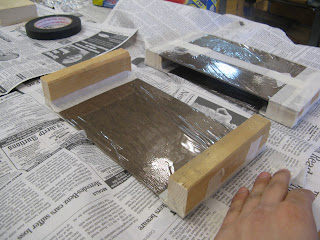


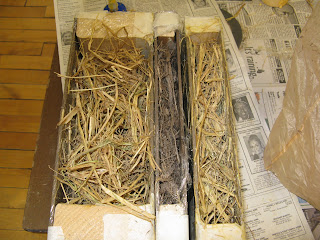


-I saw rice straw is naturally tied-up and knotted. Instead on compressing it I mixed it with glue and was seeing if it would hardened up into a brick form that would still be filled with empty space. I created rectangular spaces that straw would have to take shape in.


I also was looking how well the materials could keep a form. I dipped a ballon in glue, rubbed rice hull to cover the surface, and then repeated the process several times to build up a skin.

I also tried vacuum forming one of the balls to seal all of the material in

-I also tried the turning the sugar cane back into solid form similar to which it once was.


Sunday, March 13, 2011


Thursday, March 10, 2011
Peabody Museum visit
Seeing artifacts at the museum was a great way to start thinking about materials studies. The biggest thing I got out of the visit is that any material can be utilized to fit a need. Such as what we saw with the banana fibers ,which I assume would be a difficult material to work with, was being used in a variety of ways. If you approach a material by focusing on one "unit" at a time it is possible to see how one can create a larger form.
Thursday, March 3, 2011

Wednesday, February 23, 2011
Article Responses
The Meaning of “Social Entrepreneurship” by J. Gregory Dees
I found it interesting and agree that entrepreneurship and social entrepreneurship have different boundaries and must be held to different qualifications of success. Entrepreneurship success can be quantified and lives within a market that weeds unsuccessful attempts out. While social entrepreneurship success is hard to determine because it deals with changes within a system. The true success of social entrepreneurship is its ability to sustain over a long period of time.
The initial development of social entrepreneurship must also be different from entrepreneurship. Entrepreneurship may be spawned from a moment of genius. While social entrepreneurship process needs to be a development and adaptation to be successful.
Social Entrepreneurship: The Case for Definition by Rodger L. Martin & Sally Osberg
I do agree and like the reference of an entrepreneur as someone who questions the norm and look towards the ideal wondering why are we not there. Asking what can I do to get us there.
One of the problems I find with this article is an entrepreneur is portrayed as a lifetime profession. Entrepreneurs are described as someone who is always out seeking opportunities rather then someone who happens to address the current situation that they are living in.
Reshaping Social Entrepreneurship by Paul C. Light
I agree with the notion that an entrepreneur can be just as effective by looking at the system in place and seeing how it can be used to its full potential. Which was slightly overlooked in most of the other articles, which identifies the entrepreneur as someone who completely shakes the foundation of the current system in place.
This article shows some of the problems of social entrepreneurship today: trying to pin point success to individuals and only acknowledging huge success instead of taking note of small failures.
Subscribe to:
Posts (Atom)